Across Vero Beach—spanning Central Beach, South Beach, Royal Palm Pointe, Miracle Mile, Historic Downtown Vero Beach, and major commuter corridors along US-1, State Road 60 (Osceola Boulevard), State Road A1A, and the Merrill P. Barber Bridge—stalking and cyberstalking investigations frequently emerge from contentious divorces, child-custody disputes, broken romantic relationships, or neighborhood disagreements. When officers with the Vero Beach Police Department (VBPD), deputies from the Indian River County Sheriff’s Office (IRCSO), or officers with the Indian River Shores Public Safety Department respond to a complaint, they are routinely handed a stack of selectively cropped text message screenshots, call logs, or social media printouts and asked to make an immediate arrest.
In the 19th Judicial Circuit Court at the Indian River County Courthouse in Vero Beach, however, criminal liability under Florida Statute § 784.048 requires far more than one-sided accusations or uncomfortable communications. Whether the State files a First-Degree Misdemeanor stalking charge under § 784.048(2) (punishable by up to 1 year in county jail) or elevates the allegation to Third-Degree Felony Aggravated Stalking under § 784.048(3) or § 784.048(4) (carrying up to 5 years in Florida State Prison), Board Certified Criminal Trial Specialist Jonathan Jay Kirschner scrutinizes the digital metadata, statutory elements, and constitutional boundaries of every piece of evidence.
The "Legitimate Purpose" & Objective Distress Standards Under Florida Statute § 784.048
Under Florida law, both physical "harassment" and electronic "cyberstalking" share strict statutory definitions that prosecutors must prove beyond a reasonable doubt. Under Fla. Stat. § 784.048(1)(a) and (1)(d), the State cannot simply show that a complainant felt annoyed, offended, or inconvenienced by repeated messages or public encounters. Instead, three core evidentiary thresholds govern every Vero Beach stalking prosecution:
- The "Legitimate Purpose" Statutory Bar: Conduct or electronic communications cannot legally constitute harassment or cyberstalking if they serve a legitimate purpose. Under controlling Florida Fourth District Court of Appeal (4th DCA) precedent, messages concerning shared child-custody exchanges, school schedules, joint financial obligations, property retrieval, debt repayment, or ongoing civil litigation serve a recognized legitimate purpose—even if the tone is heated or unwelcome.
- Objective Reasonable-Person Emotional Distress: Whether a course of conduct causes "substantial emotional distress" is evaluated under an objective reasonable-person standard, not the subjective sensitivity of the accuser. Mere irritation, frustration, or mild anxiety does not satisfy the statutory threshold required for a criminal conviction.
- First Amendment Constitutionally Protected Speech: Florida Statute § 784.048(1)(b) explicitly excludes constitutionally protected activity from the definition of a "course of conduct." Public commentary, consumer reviews, or speech directed to the public rather than targeted privately at an individual is shielded by the First Amendment.
The Florida Complete-Context Rule:
Complainants routinely present Vero Beach officers with isolated screenshots showing only the accused's replies while omitting dozens of prior messages in which the complainant initiated contact, argued back, or invited communication. Subpoenaing full-thread carrier extractions and complete social media archives routinely exposes mutual communication and defeats the State’s narrative of unilateral harassment.
How Stalking & Cyberstalking Evidence Fails Under Courtroom Scrutiny
Digital and observational evidence frequently collapses when tested against the Florida Evidence Code and 4th DCA appellate standards. The table below illustrates how common categories of stalking evidence compare between the State's theory and the legal reality in the Indian River County Courthouse:
| Evidence Category |
Prosecution Theory |
Critical Defense Vulnerability |
19th Judicial Circuit Courtroom Reality |
| Treats printed screenshots provided by the complainant as self-proving admissions by the accused. |
Screenshots are easily altered, lack metadata headers, and omit incoming messages that establish mutual contact or legitimate purpose. |
Inadmissible without strict authentication under Fla. Stat. § 90.901 and complete-thread context. |
| Assumes anonymous VoIP calls or fake Instagram profiles belong to a former partner or neighbor. |
Commercial spoofing apps and VoIP relays mask true origin; an account handle alone does not prove physical authorship. |
Subpoenaing carrier IP logs and device extractions frequently disproves attribution. |
| Claims seeing the defendant near US-1, State Road 60, or the Barber Bridge proves willful "following." |
Vero Beach relies on narrow bridge crossings and shared retail corridors; coincidental presence lacks "continuity of purpose." |
Subject to Judgment of Acquittal (JOA) without proof of targeted surveillance. |
| Charges felony Aggravated Stalking (§ 784.048(4)) based on a single alleged message or indirect post. |
Requires proof of actual service/notice of the order AND repeated malicious acts, not a single accidental contact. |
Lack of verified service or single-incident contact defeats felony aggravated charges. |
Digital Authentication, Spoofing & Metadata Verification Under Fla. Stat. § 90.901
In cyberstalking cases prosecuted in Vero Beach, the central evidentiary battleground is authentication under Florida Statute § 90.901. Because anyone with a smartphone can create a mock text-message image or register a free social media profile using another person’s name and photograph, Florida appellate courts prohibit prosecutors from introducing electronic messages simply because the complainant’s phone displays the defendant’s name or phone number.
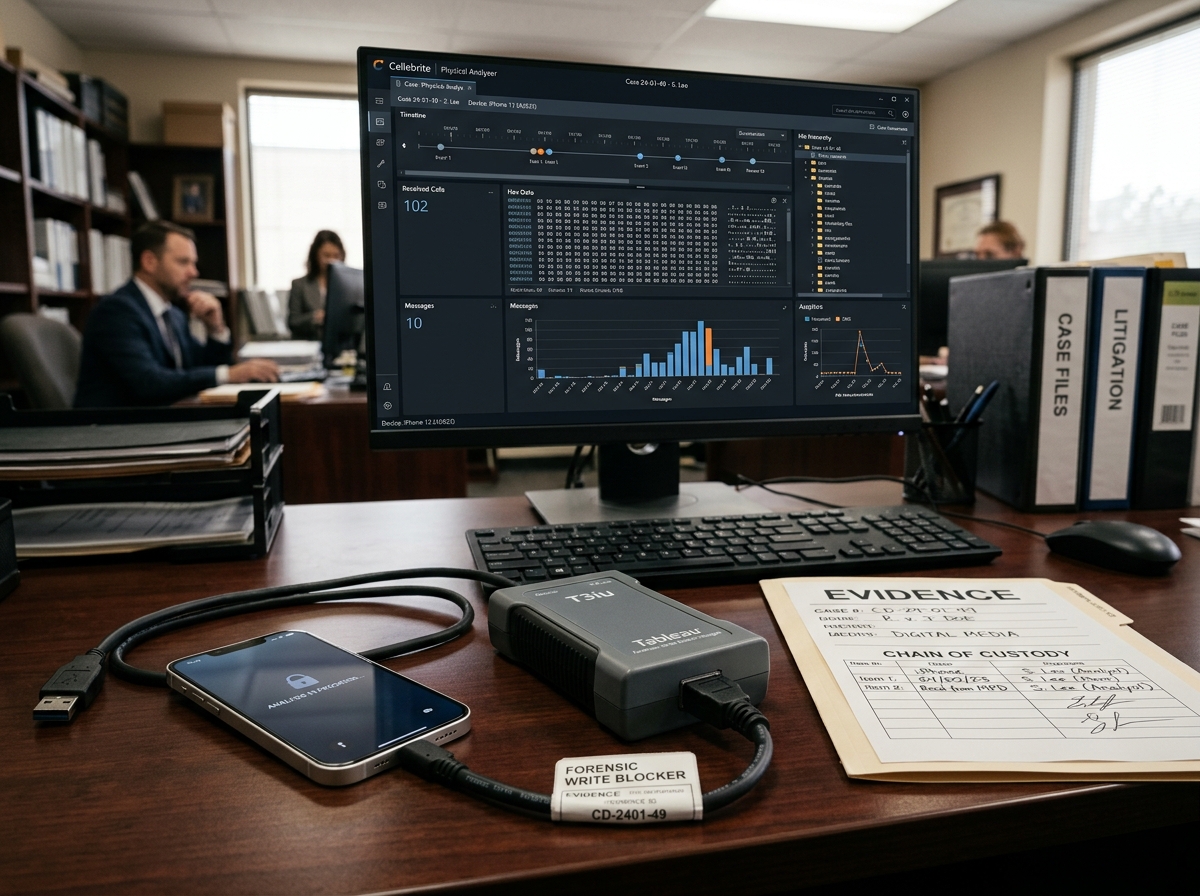
To authenticate electronic evidence at trial, the State must present corroborating circumstantial or forensic proof—such as certified wireless carrier records, subscriber IP logs, device forensic extractions, or unique internal content known only to the sender. When defense counsel subpoenas underlying server logs from Meta, Google, Apple, or VoIP providers (such as TextNow or Google Voice), the records frequently reveal IP addresses originating outside Indian River County or tied to third parties—proving the accused never sent the messages.
Fourth Amendment Device Warrants & Cell-Site Location Boundaries
When Vero Beach detectives seek to prove cyberstalking or unauthorized account access under Fla. Stat. § 784.048(1)(d)2, they often apply for search warrants to seize personal smartphones, laptops, or historical cell-site location information (CSLI). Under the Fourth Amendment, Article I, Section 12 of the Florida Constitution, and Florida Statute § 933.05, electronic search warrants must be executed within 10 days and must describe with strict particularity the specific date ranges and communications sought.
- Overbroad Digital Sweeps: Warrants authorizing detectives to rummage through years of unrelated photographs, banking records, and private messages violate Fourth Amendment particularity standards and are subject to pre-trial suppression.
- Cell-Tower Radius Limitations: Historical CSLI records only place a phone within a broad cellular sector spanning miles across Vero Beach and Sebastian—never inside a specific parking lot, residence, or driveway.
- Credible Threat Corroboration: To elevate misdemeanor stalking to felony aggravated stalking under Fla. Stat. § 784.048(3), prosecutors must prove an explicit or implied "credible threat" made with the apparent ability to carry out harm—a high evidentiary bar that hyperbole or venting fails to meet.