When law enforcement agencies operating in Okeechobee County—such as the Okeechobee County Sheriff’s Office (OCSO), the City of Okeechobee Police Department, or specialized regional units of the Florida Department of Law Enforcement (FDLE)—initiate an internet crime prosecution, they present digital records as indisputable scientific proof. Detectives arrive with Internet Protocol (IP) logs, telecom subscriber records, and automated mobile extraction reports, attempting to persuade judges, juries, and suspects that a digital breadcrumb is the modern equivalent of DNA left at a crime scene.
In Florida criminal courts, however, digital evidence is fraught with procedural defects, network transmission gaps, and severe authentication barriers. Under the Florida Evidence Code (Florida Statutes Chapter 90) and the Fourth Amendment to the United States Constitution, electronic records do not speak for themselves. Board Certified Criminal Trial Specialist Jonathan Jay Kirschner analyzes these technical vulnerabilities to ensure prosecutors are held to their constitutional burden of proving guilt beyond a reasonable doubt rather than relying on digital presumptions.
Can an IP Address Alone Prove Guilt in Okeechobee County Prosecutions?
The standard foundation of an internet crime investigation in Okeechobee begins with an administrative subpoena served upon an Internet Service Provider (ISP)—such as Comcast Xfinity, CenturyLink/Brightspeed, or satellite providers like Starlink and HughesNet. The ISP responds with an account printout identifying the individual whose name appears on the monthly billing statement for the internet gateway at a specific physical location in Okeechobee County.
Prosecutors routinely assume that the account subscriber must be the perpetrator who transmitted an unlawful electronic communication, committed computer tampering under Florida Statute § 815.06, or accessed prohibited digital databases. In forensic science and criminal defense, this assumption is fundamentally flawed due to three critical technical realities:
- Gateway Resolution vs. Individual Attribution: An IP address resolves solely to an external modem, antenna, or network interface card. It provides zero technical identification of the individual person typing on a keyboard or operating a mobile touch screen.
- Rural Ranches and Multi-Structure Wireless Networks: In Okeechobee County, residential properties frequently span expansive acreage featuring main homes, detached workshops, barns, tenant dwellings, and guest quarters. Long-range Wi-Fi extenders, unencrypted mesh routers, and outdoor access points allow family members, hired ranch hands, contractors, and visitors to access the internet through a single subscriber gateway.
- Open Wi-Fi, Satellite Transmissions, and Third-Party Intrusion: Routers utilizing factory-default passwords, outdated WPA security protocols, or public guest portals permit unauthorized third parties to park nearby, connect to the signal, and route illicit traffic through an innocent property owner's network without their knowledge.
The Florida Attribution Standard:
Florida courts have consistently established that proof that an illicit transmission originated from an IP address registered in a defendant's name is legally insufficient, standing alone, to sustain a criminal conviction. The State must introduce independent, admissible evidence proving physical custody and keyboard operation during the precise seconds the alleged digital offense occurred.
How Digital Evidence Fails Under Forensic and Courtroom Scrutiny
Electronic evidence frequently collapses when subjected to rigorous cross-examination and independent technical defense testing. Below is how four common categories of digital evidence compare between the State's theory and the evidentiary reality inside the Okeechobee County Courthouse:
| Evidence Category |
Prosecution Theory |
Critical Defense Vulnerability |
Okeechobee Courtroom Reality |
| Proves the subscriber committed the cyber offense from their Okeechobee address. |
Identifies only the modem; cannot distinguish between household members, agricultural workers, tenants, or drive-by Wi-Fi users. |
Legally insufficient for conviction without corroborating physical device evidence or sworn admissions. |
| Extracts deleted messages, web search history, and location logs as conclusive proof of intent. |
Extractions routinely exceed the four corners of the search warrant; timestamps frequently misalign due to UTC time-zone shifts. |
Subject to Fourth Amendment suppression if detectives execute general exploratory searches. |
| Places the suspect device in the geographic proximity of an alleged cyber transfer. |
Rural cell towers cover vast geographical radii in Okeechobee; reverse-location geofences sweep in innocent citizens without individualized probable cause. |
Subject to constitutional challenge under Florida search warrant particularity mandates. |
| Automated software claims a complete unlawful file was shared from the target IP address. |
Software frequently logs partial, corrupt data packets without proving a decipherable, usable file was ever stored on the physical drive. |
Independent defense drive imaging frequently demonstrates file corruption or total absence. |
How Search Warrants for Devices Violate the Fourth Amendment
In internet crime cases, search warrants represent the primary constitutional battleground. Because modern smartphones, tablets, and personal computers contain massive volumes of private information—spanning personal photographs, privileged medical history, financial records, and confidential correspondence—the United States Supreme Court held in Riley v. California that electronic devices require heightened Fourth Amendment protection.
Under Florida Statute § 933.05, search warrants issued by an Okeechobee County magistrate must be executed and returned within 10 days from the date of issuance. Furthermore, the warrant affidavit must establish clear probable cause and state with strict particularity the specific digital items to be seized and the precise data categories to be examined. When detectives draft overbroad warrants authorizing the search of "any and all computers, electronic storage media, images, and communications," the warrant functions as an unconstitutional general warrant.
Jonathan Jay Kirschner challenges these overreaching procedures by filing formal Motions to Suppress under the Fourth Amendment and Article I, Section 12 of the Florida Constitution. When detectives examine personal records outside authorized date ranges, bypass filter protocols, or seize hardware without a nexus to criminal activity, the resulting evidence can be excluded from trial, undermining the prosecution's case.
Chain of Custody and Cryptographic Hash Verification (SHA-256)
Digital evidence is volatile. Simply booting up a seized laptop, updating an operating system, or allowing a mobile phone to communicate with a cellular network alters system metadata, rewrites temporary caches, and destroys original access timestamps. Digital forensic examiners must adhere strictly to federal standards established by the National Institute of Standards and Technology (NIST SP 800-86):
- Immediate Radio-Frequency Isolation: Seized smartphones must be placed immediately into Faraday bags or metal boxes to prevent remote wipe commands or incoming over-the-air data modifications.
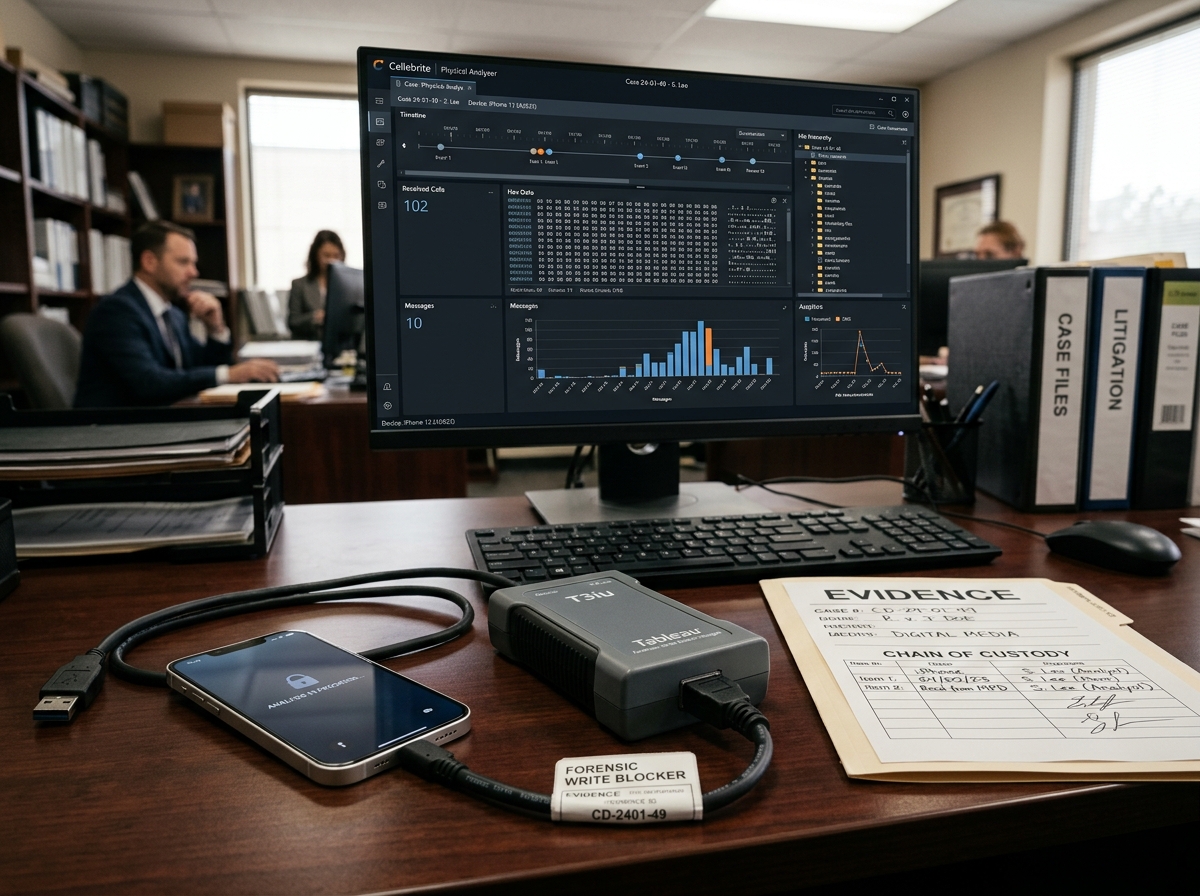
- Hardware Write-Blockers: Prior to previewing or acquiring data from a computer hard drive or SSD, examiners must connect the device through certified hardware write-blockers to prevent a single byte of data from being altered.
- Cryptographic Hash Integrity: Examiners must generate mathematical checksums (such as SHA-256 or MD5 hashes) of the original storage media, produce a bit-stream forensic clone, and confirm that the clone's hash value matches the original media identically.
If the State Attorney’s Office cannot establish an unbroken, documented chain of custody, or if defense forensic experts identify hash discrepancies between intake and final courtroom disclosure, the reliability of the State's technical evidence is severely compromised.